
Searching St. Louis County Civil Dockets
Missouri Case.net is the statewide public entry point for any St. Louis County civil case. Search by case number first when you have one. Otherwise run a litigant-name or filing-date search. Narrow the court location, and open the matching Case Header. Check the case style and party roles before assuming an entry belongs to the right matter. Remember that the independent City of St. Louis is a separate court location from St. Louis County.
Searching and document access are two different things on Case.net. A civil docket entry can identify a filing or a scheduled event. The attachment may still stay off the public view. For a fuller name-and-number workflow, the county's Case Lookup page walks through the statewide search paths. It never replaces the clerk's record role.
- Use the civil case number first, or search by party name and then by filing date if needed.
- Choose St. Louis County and verify the case header, style, parties, filing date, and division.
- Open Docket Entries and note the date, entry text, service event, setting, and linked document status.
- Read a setting with the related order or notice, especially if it was continued or vacated.
- Give the clerk the case number and exact document or judgment date when requesting a copy.
St. Louis County Associate Civil Dockets
Civil records in St. Louis County run through several lanes: circuit civil, associate civil, small claims, domestic-relations and family, probate, and specialized divisions. The division named in the case header matters far more than a loose label like "civil."
Missouri Revised Statutes § 517.011 gives associate divisions civil jurisdiction up to $25,000, exclusive of interest and costs, subject to the statute's own categories and limits.
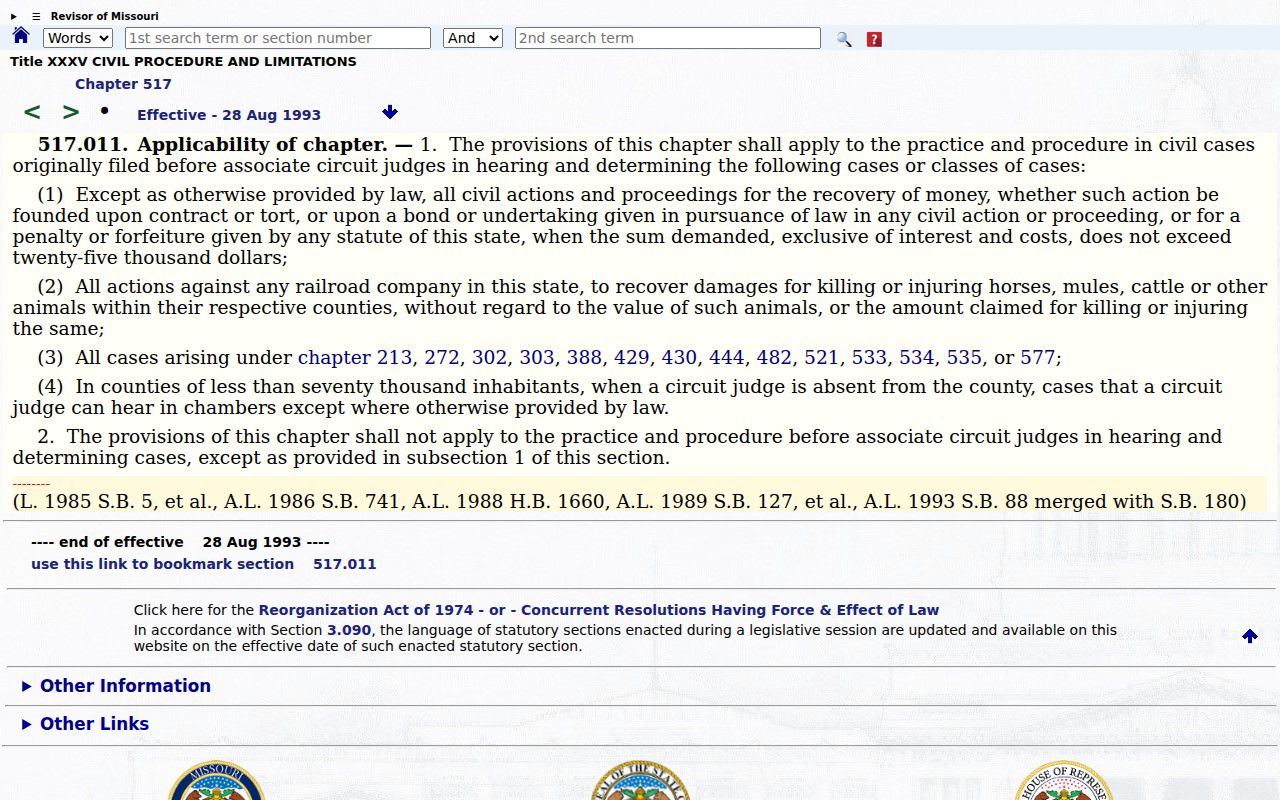
The statute supplies the jurisdictional frame. For any particular St. Louis County civil docket, the Case.net case header supplies the actual court location and category.
Inside a St. Louis County Civil Docket
The Case Header tells you the number, case style, court or location, filing date, and category. Parties and roles appear there, along with whatever division context is visible. From there the docket records dated procedural events. Civil matters can show an initial petition or complaint, summons and return of service, an answer or counterclaim, motions, and discovery entries. A scheduling memo, settlement activity, judgment, garnishment, satisfaction, or an appeal entry may also appear.
"Filed" and "scheduled" are not outcome words. A return of service only records service attempted or completed. It does not resolve the claim. A judgment label means little alone. Read it with the entered document and its date. Some case types expose financial, service, or garnishment metadata. But absence from the public display never proves the event failed to occur.
| Case number | Missouri's older conventions use a two-digit year, category, and sequence; newer numbers add location, category, sequence, and subcase elements. |
|---|---|
| Parties and roles | The Case Header distinguishes plaintiffs or petitioners from defendants or respondents before filings are read. |
| Service history | Summons, service, and return-of-service entries show procedural delivery efforts, not resolution of the claim. |
| Motions and settings | Entries can record a motion hearing, call docket, dismissal docket, trial, or continued date and time. |
| Judgment history | Look for the entered judgment, dismissal, satisfaction, or appeal event rather than relying on a single status word. |
St. Louis County Civil Docket Memos
The county's Civil Order/Memo form shows the working vocabulary behind many civil settings: call docket, dismissal docket, trial, motion hearing, and jury trial. It also carries a continued date and time. In-person and by-consent options sit there too. The separate Civil/Criminal Docket Memo adds a track number, trial length, settlement conference, appearances, and a passed-for-settlement option.
Those forms explain why a civil docket may show a formal setting. The motion, proposed order, or service document may not be linked in the public view. They also warn against reading a calendar entry as the final account of what happened. The Civil/Criminal Docket Memo says a copy of the order can be the only notice. So keep the court notice and get division confirmation rather than relying on an alert alone.
A case can seem to go quiet. Ask the division clerk whether a docket memo, proposed judgment, or dismissal filing has come in. Ask when it should appear too. That question beats two bad assumptions. One is that a proposed document means the court has ruled. The other is that an older setting still stands after a continuance.
Civil Case Types on the Docket
Category and division help separate the civil record lanes. A contract or other general civil claim can travel differently from a small-claims matter, a probate file, or a family case. Read the case style, category, and court location together before assuming a similarly named case sits in the same division or follows the same service and hearing procedures.
- Circuit civil matters involving larger or general civil claims.
- Associate civil matters within the statutory jurisdiction described in § 517.011.
- Small Claims money matters with a $5,000 limit.
- Domestic-relations and family matters with their own access boundaries.
- Probate and other specialized circuit-division case files.
The county's Small Claims information confirms the $5,000 money-claim limit and sends filers to 105 South Central. It also notes that the division does not offer every remedy a civil litigant may seek.
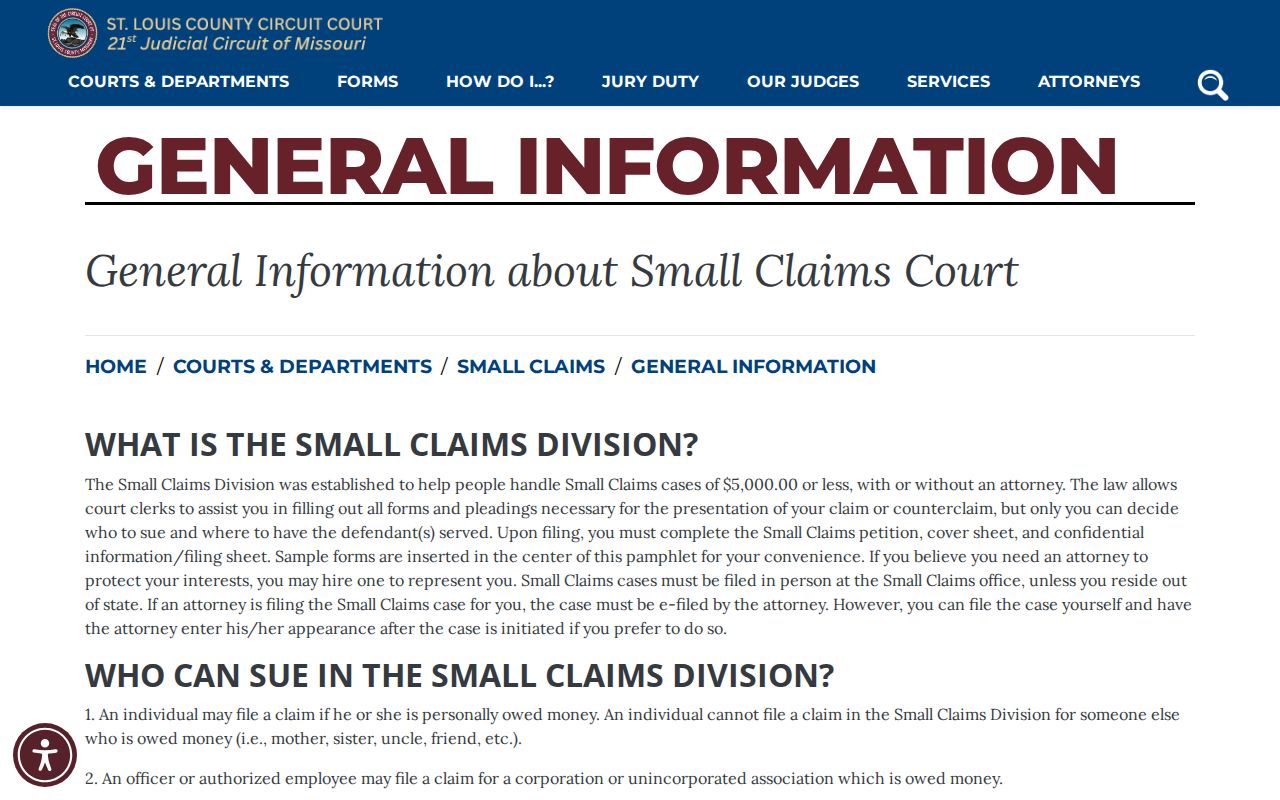
Small Claims is one associate-civil lane, not a label for every local civil docket or municipal case.
Municipal ordinance enforcement runs through the municipal division, with its own court calendar and local staff, while a private money claim may sit in associate civil. Check the case number, division, and jurisdiction before describing the case, so the two record systems never get mixed together.
St. Louis County Civil Filing and Service Entries
Every fresh St. Louis County lawsuit starts with paperwork. The clerk needs to read it at a glance. The county's associate-civil and bulk-filer guidance tells filers what a new petition needs. It should state the amount sought. It should give the primary nature of the Count 1 action. A service address goes with it. Lease or contract material rides along when the cited rule calls for it. Later, the civil docket may list service events. One caution, though: an entry by itself does not show every attachment. It does not prove any claim has been decided.
Timing rules fill much of that same guide. Under Operating Rule 17, service is supposed to happen within 180 days. Memos and judgments must reach the clerk three business days before docket. Some post-docket and dismissal-docket filings carry a 24-business-hour instruction instead. All of that binds the filer, not the public calendar. A docket entry may lag behind what a lawyer has already handed in. A filing, memo, or judgment may seem missing. Ask the division clerk whether it is expected.
Viewing the docket costs nothing. Filing and service are another matter. The county's 2026 schedule puts the clerk charge for the relevant associate-civil cases at $53.50. Sheriff service costs extra. The amount shifts with the service variant you pick. Family, probate, garnishment, appeal, and copy requests run on other schedule lines entirely. Check the exact PDF entry for your particular request before sending money.
Civil Docket Settings and Hearings
A setting is only a scheduled court event. It is never proof it happened. In a St. Louis County civil case, the docket memo may list a call docket, dismissal docket, motion hearing, trial, or jury trial. Other entries note a continued date. Or they may note a settlement event. Before you travel or prep for an appearance, weigh the event date against the notice, any related order, and the division's instruction.
Case.net's Scheduled Hearings & Trials Search is handy when you want a date-focused result. The case header and Docket Entries add the procedural context around that date. A division page can also say whether a hearing happens in person or through Webex. Confirm any continuance, cancellation, or remote setup with the assigned division. The public case index never replaces the court's own notice.
When you record a setting, start with the case number. Capture the date and time too. Add the division or judge, the location or remote method, and the proceeding type. Note the status as well. Events can be future, continued, vacated, or completed. That compact record pays off later. It lets you line up a docket entry against the prior notice. If the two clash, ask the division one sharp question.
St. Louis County Civil Document Copies
The Circuit Clerk FAQ draws a line between ordinary, certified, and authenticated copies. To request a judgment, order, dismissal, or other filed paper, start with the clerk. Hand over the case number. Give the parties and their roles too. Say which copy type you want. Also say whether you need the complete file or one document. An approximate filing or judgment date helps as well. Payment comes before release, and offsite cases take at least three working days.
| Need | Local record route |
|---|---|
| Public case index or entry history | Search Case.net and preserve the case number, event date, and entry wording. |
| Public electronic document | Use a hyperlinked entry when access is available, or ask for courthouse-terminal instructions. |
| Certified judgment or order | Request it from the Circuit Clerk with the exact case and document details. |
| Offsite file | Allow the county's stated minimum of three working days before release. |
St. Louis County Civil ECASE Access
File Viewer Help splits the public docket from the documents behind it. A hyperlinked entry can open an attachment when the document is public and you have access. A text-only entry may mean no attachment exists. Or it may mean one exists but stays out of reach. The ECASE tag signals an all-electronic file. It does not mean every document is open to anonymous remote viewing.
Missouri's eFiling materials explain that public users may have to visit a courthouse terminal for electronic public documents. Attorney access turns on registration, role, and document security. So the strongest record request names the specific entry and document rather than treating a missing PDF as a missing filing.
The county contact information points public case-file users to Case.net and to the Circuit Clerk for paper copies. The web contact form cannot file a pleading. It cannot reach a judge or hand out legal advice. For a civil document question, your real options are the public index, the clerk counter or a copy request, and a courthouse public-access terminal where staff authorizes use.
Civil Docket Access Rules
Missouri Operating Rule 4 keeps the automated index searchable by name, case number, and filing date, while shielding confidential cases, indexes, and docket sheets from unauthorized public access. A civil header can be public even as one of its documents sits secured or redacted. Family, juvenile, mental-health, sealed, and expunged material often carries stricter statutory or court-rule limits than an ordinary civil entry does.
Access rules:
Missouri Revised Statutes § 610.010 defines public records and addresses judicial entities in their administrative capacity.
Missouri Revised Statutes § 610.023 supplies inspection, copying, and response rules for covered governmental records.
Missouri Revised Statutes § 610.120 limits public access to closed records.